Architect Spotting
To call yourself an Architect in the UK you must be registered with the ARB - the title is protected by Act of Parliament
Supposedly spot an Architect in the street as the one person looking up while walking along (some truth in this)
Architect protected

Architects
The National Park is increasingly one large village. A strong rural character is still present in the long-term residents. If you buy a property in the area you have to accept that most local people will know a lot about you if not within days then certainly within the first few weeks. It is a good thing in many ways as even the most famous residents don't get bothered which is possibly part of the reason they come.
There is a tradition of personal recommendation which still thrives. Whether you are looking for an Architect or a chimney sweep asking around will usually produce honest opinions.
To my mind this is a sensible approach.
Nearly all my work comes from recommendation - but that probably reflects the rural location.
Websites are a good tool. I find that clients often use my site as a reference check before getting in touch to have an initial chat.
Commercial Listings and Directories
Choosing any firm out of such as Yellow Pages is a bit of a lottery and long ago I removed my Yellow Pages advertisement however I do know that some colleagues get work from advertising in YP and/or yell.com.
There are a number of online listings of Architects of generally poor quality and often include non-Architects (see Architects Registration Board (ARB) in next section).
Royal Institutes - what's that all about?
RIBA
Many, but by no means all, UK Architects are members of the RIBA (Royal Institute of British Architects) and affiliated home nations' Institutes RIAS, RSAW and RSUA.
Membership allows Architects to call themselves 'Chartered' and have the letters 'RIBA' after their name. I am a member of the RIBA and also of the RIAS (see below)
The RIBA maintains online databases of members and Practices however it only promotes Practices and excludes from listing or promotion the many Practices who do not subscribe to its 'Chartered Practice' scheme. I once subscribed to this but eventually decided it was aimed at promoting larger practices.
RIAS
The RIAS is the Scottish equivalent of the RIBA and they have longstanding agreements to work together.
Although long based in Ambleside I am a member, being born in Scotland (Inverness), studying Architecture at Edinburgh University and working in Scotland before I moved to a Practice here many years ago.
Also working close to the border it helps to understand what is going on in Scotland.
Architects Registration Board
The ARB
The title 'Architect' is protected under UK law and every architect practicing in the UK must be registered with the Architects Registration Board (ARB).
Notwithstanding the proliferation in recent years of such titles as Software Architect, Landscape Architect, Interior Architect, Architectural Designer, Building Designer etc. etc. the title Architect is limited to those Registered with the ARB.
The ARB has a rather good web site with quick search facility and unlike the Royal Institutes' directories includes every architect Registered in the UK.
Complaints Procedures
All of the above organisations have Codes of Conduct for members and offer complaint and dispute resolution guidance and procedures linked via their websites (some more prominent than others - here are the links)
The Codes of Conduct require that I have my own disputes procedure in place. Thus in the first instance if any Client feels they have a complaint (or even a 'minor grumble') they need to let me know as soon as possible so that it can be addressed promptly. The goodwill and confidence of Clients is of prime importance and maintaining good relations and communication is vital to every project.
Working on a typical project
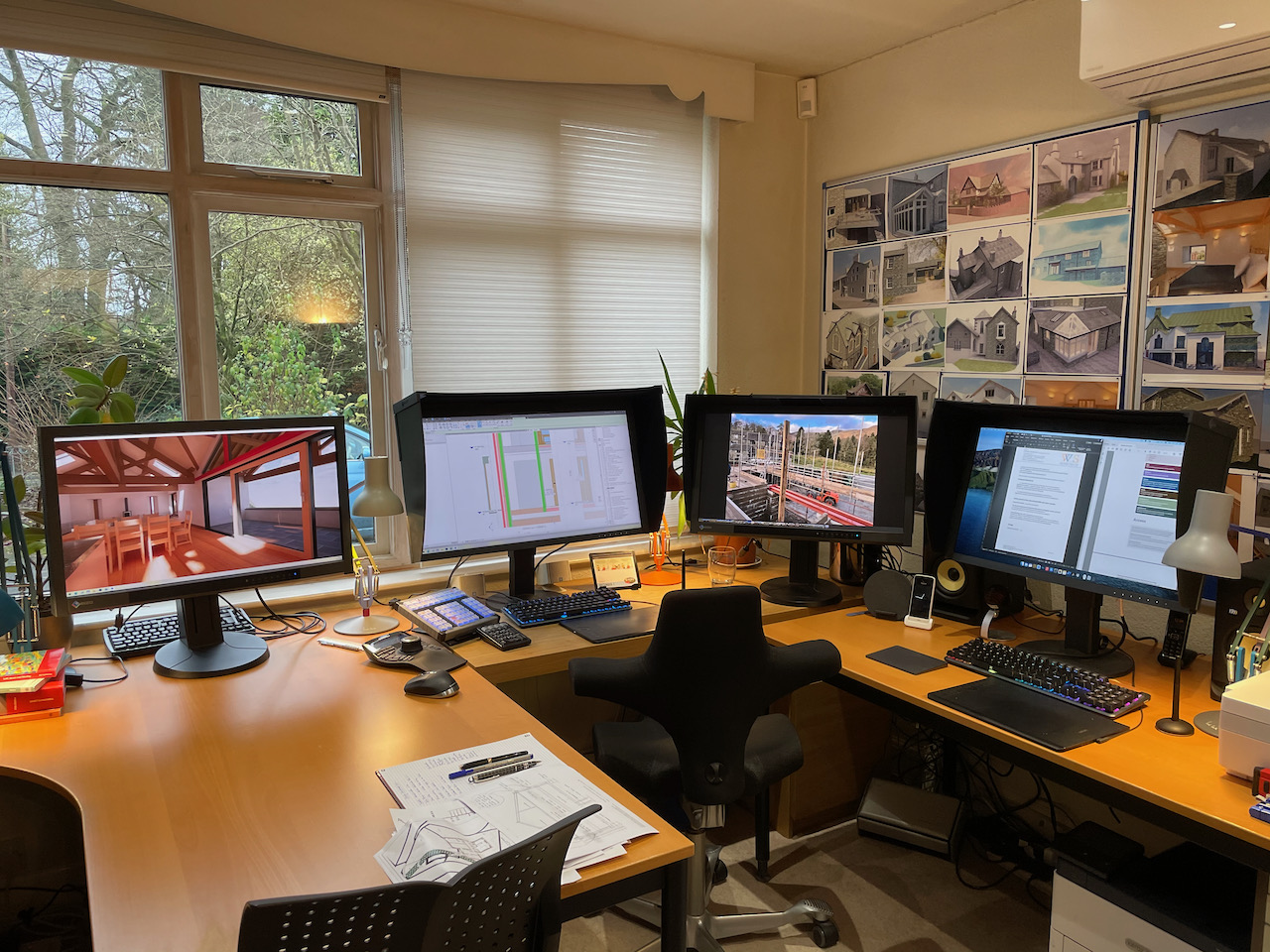
My usual work environment but adjusted here for an imminent client meeting.
From the model to rendered output
The Autodesk Revit building model produces the drawings semi-automatically and also updates them in real time. For client presentations I link the model into real-time rendering software (i.e. using a computer screen and 'spacemouse' to wander around inside the virtual building)
Despite all the technology employed routinely I like my drawings to still look like drawings. There is an example linked below the picture underneath this paragraph.

Design work in progress - proposals for a house extension above in Little Langdale - rendered computer model


Architect Services
Working with an Architect... how to get started?
In my case telephone or email usually and we have an informal chat. It doesn't need to be about an imminent job I will answer any query as best I can. Social media is also fine - links are at the top left of this page.
Within reasonable distance I don't mind meeting up for a no-obligation chat on site. If this goes well then I usually suggest obtaining a quote for a measured survey. In the past I would do my own measuring but professional land surveyors using total stations or occasionally laser scanners produce very accurate data which can be brought straight into my 3D cad system.
There isn't a standard pattern to be honest - every job is different and I try to be as flexible and accommodating as I can.
Stages in a project
A Rough Guide - every project is different
Broadly speaking the headings below are a reasonable summary of how jobs proceed although every job is different and I doubt if I have ever seen one which went exactly as the list, but it is a useful read.
On some projects stages are 'telescoped' by clients eager to get work under way immediately after planning consent and on many jobs now detail design is a rolling programme. I tend to work on these types of job with a team of trusted contractors who can handle the demands of such a process and still produce very high quality workmanship.
The RIBA (see left) famously produces a 'Plan of Work' document with nicely set out stages and procedures but while an interesting reference work I have never seen it used directly in a project but worth a look via the link
- 1. Initial contact, arrange meeting for informal discussion.
- 2.A If appointed, agree terms (I send you a fee estimate on hourly rate and likely hours to planning application stage based on past projects) plus point out regulatory things such as appointments you need to make under Health & Safety legislation and the new Building Regulations. It is often a good idea at this early stage to obtain quotations for any bat survey that might be required (for slate roof alterations?, stone wall alterations?) as this can be very slow if an 'emergence survey' is deemed to be necessary by the bat surveyors as these can only take place between May and September. Other surveys may need to be set up - structural perhaps (e.g. for barn conversions), or flood risk assessments, drainage, electric supply, water supply, access issues etc.
- See Charges page
- Increasingly I find it useful to swap 2.B with 2.A. The reason being that once you have the measured survey I can turn it into plans and elevations to give some paper prints for us to meet up and sketch on the paper drawings. I then have a better idea of what clients are looking for which saves abortive design work and I can make a more accurate assessment of likely amount of time needed to achieve an agreed design.
- 2.B Do measured survey (I now recommend a local firm of land surveyors to quote for the measured survey).
- 3. Draw/model up the existing layout (can be omitted if it was done earlier - see above).
- 4. Draw/model up a design (3 & 4 often merge together). It isn't always necessary to model the existing property as the survey drawings I prepared earlier will suffice for 'plans as existing' for any planning application. As well as 'drawings' the 3D cad system allows videos to be produced and clients normally come into my office to discuss the design interactively with the 3D model live on large computer screens. Changes can often be made in real time and the system updates all the drawings automatically. I like my drawings to look like traditional drawings but in fact they are all interactively linked to the 3D building model which makes for a great time saver but more importantly helps clients understand the proposals. At this stage it is also quite common to need the services of a structural engineer to advise on any existing or new structural elements. There is one I can recommend or there are several larger firms in the County.
- 5. Discuss with clients and amend (repeat as necessary until clients are happy). At this time I often bring in or have some initial discussions with likely builders, checking availability etc. as they can have a really useful input to practical aspects of not just the design and materials but also Health & Safety and Building Regulations potential issues.
- 6. Make any Planning Applications on client's behalf. In some projects it can be worth employing a specialist Planning Consultant. I can recommend one. Not every job requires a planning application of course but most I see do.
- 7. Wait for Planning Consent or resolve any issues if the appointed case officer is willing. By and large the National Park planners struggle to give decisions within the 8 week government target period but they do their best and I always aim to keep good relations with the planners.
- 8. After Planning Consent discuss next steps with clients - how they would like to run the project - talk to builders again if one not already appointed.
- 9. Draw up detail plans (this can vary in scope and time enormously depending on the choice of main contractor). There are a handful of really good builders in our area and all are in great demand. Thus almost all jobs are negotiated rather than tendered for. Tenders are possible but most of the work I see is negotiated with a preferred builder. Some idea of cost is always discussed and some clients like to employ, at least in the initial stages, a Quantity Surveyor, to produce a budget estimate based on the proposals.
- 10. Make Building Regulations application. Building Regulations have changed recently inasmuch as the (their new name) Registered Building Inspector from the local authority is not there to advise on design or choice of materials etc. any more but to carry out inspections at specific points in the construction. There are appointments clients need to make under both H&S and Building Regulations legislation. On domestic residential projects these appointments will default to such as myself and the main contractor if not formally appointed in writing by the clients. In both sets of legislation these appointments are known as Principal Designer and Principal Contractor - which is confusing but I imagine the government may eventually roll up the Building Regs and H&S CDM Regs into one set. Depending on how the construction phase is organised these titles can shift - e.g. the Principal Contractor could in some circumstances also be the Principal Designer (e.g. if they are making all the detail decisions on site during construction phase).
- 11. Agree choice of contractor(s) with client...
- 12. The following points 13. to 16. are traditionally how formal contracts would run and on many commercial and some larger domestic scale projects where standard forms of contract are used the involvement of architects in running the job on site - as Contract Administrator - still occurs.
- However the reality within the National Park is that most local contractors that I see - even the best in the area - will not sign a formal form of building contract (e.g. JCT Minor Works). Thus I am not in charge of the works - as CA (Contract Administrator) and clients and builder will often work on domestic scale projects closely together. I then advise as requested on technical aspects - most frequently on insulation levels plus liaising with such as heat pump or solar panel specialists. Then sometimes there are changes made during construction some of which may require an amended planning application.
- On larger residential projects I quite often stay involved in the detail design but it is usually just responding to requests for information and detail drawings by the main contractor. The best builders locally are also very good project managers with good communication skills - vital when many of the projects are for clients who may not live locally all the time.
- Despite the lack of formal contracts it is important to check insurances for all parties. Payment terms are nearly always these days accounts submitted monthly, any queries within a few days and payment within 2 weeks maximum. Local builders won't stand for retentions on their interim claims as featured in standard forms of contract. They say they always stand by their work. This is another reason to be using the best local builders.
- These last points below relate to a formal form of building contract being used on the project (see 12. above):
- 13. If appointed to run the job arrange for formal acceptance of prices and start of work on site.
- 14. If appointed to do so carry out periodic inspections of the work
- 15. Sort out any problems that arise during the works
- 16. If appointed to do so certify contractor's claims for payment and agree final account.

William Sutherland rias riba
Chartered Architect
Director
Cluan, Rydal Road, Ambleside LA22 9BA
Tel: 015392 51006

Please Note my new
telephone number:
015392 51006

Although Cookies are currently not set by this web site visitors are deemed to accept them


